Before the Grid: How Printed Pages Learned to Organize Information
Learn how printed page layout moved from hand-set decisions toward repeatable systems, and how to read the choices that organize an old page.
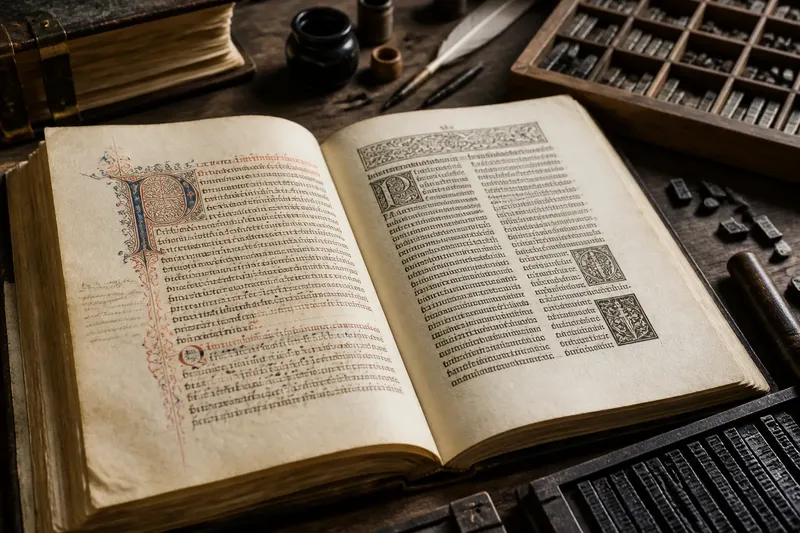
Printed page layout became easier to repeat when printers could reuse type and familiar arrangements. Before the grid, a page’s organization depended more directly on the manuscript, the materials at hand, and the compositor’s decisions. That history is not a straight march from disorder to order; it is a series of ways to manage recurring problems such as fitting text and separating kinds of information.
A grid is not simply a set of invisible lines. It establishes relationships among margins, columns, images, captions, and headings. Those relationships can make pages easier to coordinate, but they do not explain every historical choice. To read an old layout carefully, distinguish what the page repeats from what it does only once.
Why was early page layout flexible?
In handwritten books, a scribe could adjust line lengths, leave space for an illustration, or add a note in a margin as work progressed. The organization depended on the manuscript and the person making it. A page could be carefully ordered without relying on identical measurements from one page to the next.
Manuscripts also used recognizable devices to establish hierarchy. A large initial could mark a new section; colored writing could distinguish a heading; marginal notes could help readers approach dense text. Such conventions created visual distinctions, but they did not require every page to share a fixed underlying plan.
That flexibility also meant that arranging a page depended on ongoing attention. A change in a passage could affect the space around it, and a scribe might shorten a line or shift a note to keep the page legible. The result could be coherent, though another copy would not automatically reproduce the same arrangement.
What changed with movable type?
Movable type let printers assemble reusable letters and spaces into lines, then arrange lines in a frame for printing. A press could make repeated impressions from that setting. This made an individual page reproducible, but did not by itself create a general grid for organizing every page in a book.
The compositor still made specific choices about line endings, text-block width, and available space. A title, woodcut, or blank area could call for a different type size or position. The press repeated the setting; the setting itself remained the result of decisions made for that page.
Early printed books also drew on conventions familiar from manuscripts. Printers used initials, headings, ornaments, and blank spaces to signal structure. Some books left room for a rubricator or reader to add color and decoration by hand after printing. These examples show how print could accommodate older habits rather than simply replace them.
There is a useful distinction between repeatability and a system. A printer could reproduce one page exactly without applying a shared rule to all pages. Identical impressions repeat a setting; a grid relates different pages through common alignments and divisions.
Why did printers use more systematic layouts?
Printed material could include main text, notes, tables, diagrams, and several levels of heading. Broadsides and newspapers had to fit separate items on a bounded sheet. When similar forms recurred, arranging each one from scratch could make coordination harder.
Printers and compositors developed practical habits for familiar formats, and publishers sometimes wanted related books to look connected. A reader also needed visual cues for where a section ended, which passage a note belonged to, or how to locate an item. These are reasons to consider when interpreting a layout; they do not establish one universal cause for the development of grids.
Some production settings made shared plans useful. A layout that could be described and revised gave contributors a common reference for margins, columns, and spacing. Such rules could organize decisions without removing the need for judgment.
What can a grid solve, and what can’t it?
A grid establishes alignments and divisions that can be reused. It may define a text area, set columns, and mark likely places for headings, illustrations, or notes. Even when its guides are invisible, repeated positions can make related elements easier to recognize.
- Check the column edges: If text blocks and images share edges, read them as parts of a common structure; if they do not, consider whether the difference marks a distinct role or a one-off adjustment.
- Check which caption sits beside each image: If placement makes the pairing clear, treat it as a grouping cue; if the pairing is uncertain, use nearby labels or the surrounding text before assigning a relationship.
- Check where headings recur: If headings occupy familiar positions, read that placement as a navigational pattern; if one heading shifts, consider whether the section has a different function before calling it inconsistent.
- Check how notes align with passages: If a marker or position connects a note to a passage, read the note as supporting that text; if the link is unclear, avoid assuming which passage it explains.
- Check whether repeated pages share margins and spacing: If they do, infer a recurring layout plan; if they vary, consider changes in content, format, or production rather than assuming there was no plan.
- Check whether an unusual element breaks the pattern: If a map or large initial departs from the common arrangement, treat it as a possible deliberate exception; if the reason is not visible, leave the purpose open.
A grid cannot decide what deserves attention, clarify weak writing, or make every page feel balanced. It offers a structure in which those decisions can be made. Like shelves, it can keep related things in recognizable places; it cannot decide what belongs on them.
Nor does a repeated arrangement eliminate exceptions. A page can use recurring columns and still give a map or opening section a different treatment. Printers combined inherited conventions, available type, production needs, and local judgment. The grid is one tool for understanding those decisions, not a point at which flexibility disappeared.
What questions help you read an old page layout?
How can you tell whether pages share a layout?
Compare margins, text blocks, headings, and image positions across several pages. Repeated alignments suggest a shared plan, while a single unusual arrangement may answer a local need such as a table or opening section.
What do changes in type size or spacing signal?
A change in size, a blank interval, an ornament, or a separate column can distinguish one function from another. Read the signal alongside neighboring material, since the same device can serve different purposes in different books.
Why might an old page have a one-off arrangement?
A table, diagram, or unusually long passage may not fit the surrounding pattern. The exception could reflect the material or the production choices available, but the page alone may not reveal which explanation applies.
Does a regular layout mean the page was easy to change?
No. A printed setting could reproduce an arrangement, but changing it involved altering the physical composition. A repeated structure may therefore reflect practical production choices as well as visual ones.
How do grids change the idea of a page?
Grids make page relationships easier to describe and repeat. They turn some isolated placements into a shared structure, while leaving room for the compositor or designer to judge where an exception makes sense.
Say a printer is preparing a small handbook with sections, diagrams, and explanatory notes. In this invented example, the starting point is a set of pages arranged separately, with the note-to-diagram relationship shifting from page to page. The printer sets shared margins and columns, places notes beside their related diagrams, and keeps headings in recurring positions; a large diagram receives a deliberate exception. The expected observable result is that the notes and diagrams form clearer pairs and the repeated sections are easier to recognize, while the unusual diagram remains distinct. The tradeoff is a more familiar pattern in exchange for less freedom to place each ordinary element wherever it happens to fit.
For anyone searching the history of printed page layout, the useful distinction is between a page that repeats and a system that relates pages. Manuscript conventions offered ways to mark importance; movable type made a setting reproducible; shared arrangements offered another way to organize related material. A grid is best read as a practical agreement about where information belongs, not as proof that every page followed the same rule.